






Data science continues to be one of the highest-paying careers in technology, driven by explosive growth in AI, big data, and machine learning. But the real question many people ask, especially students, career switchers, and professionals, is simple:
How much does a data scientist actually earn?
The answer depends on experience, location, industry, and most importantly, the employer. Companies like Meta (formerly Facebook) are known for paying top-tier salaries, often well above the industry average.
Thereby, I’ve compiled this guide to break down global data scientist salaries, then zooms in on Meta’s compensation structure, with a real-world example to show how high the ceiling can go.
What is the Average Data Scientist Salary? (USA Overview)
Across the tech industry in the United States of America, data scientists are compensated based on skill depth and business impact.
Typical Annual Salaries, According to Indeed Salary Calculator
- Entry-level (0–2 years): $80,581 – $129,385
- Mid-level (3–5 years): $207,747 – $307,747
- Senior (6–9 years): $307,747 – $407,747
- Principal / Staff: $307,747+
In tech hubs like Silicon Valley, New York, London, and Singapore, total compensation often exceeds these ranges due to bonuses and equity.
What Does a Data Scientist Do?
A data scientist turns raw data into actionable insights that help companies make better decisions, build smarter products, and gain a competitive edge.
They sit at the intersection of statistics, programming, and business strategy, working with large datasets to uncover patterns, predict outcomes, and solve complex problems. In modern organizations, data scientists play a strategic role in shaping products, user experiences, and long-term growth.
Where Do Data Scientists Work?
Data scientists are employed across industries, including:
- Technology & AI
- Finance & fintech
- Healthcare
- E-commerce
- Marketing & advertising
- Government & research
Big tech companies like Meta rely on data scientists to optimize products used by billions of users worldwide.
What Influences a Data Scientist’s Pay?
Several factors directly affect earnings:
- Technical specialization (AI, ML, deep learning, NLP)
- Business impact (revenue, growth, optimization)
- Company size & profitability
- Equity compensation
- Geographic location
- Leadership or research responsibilities
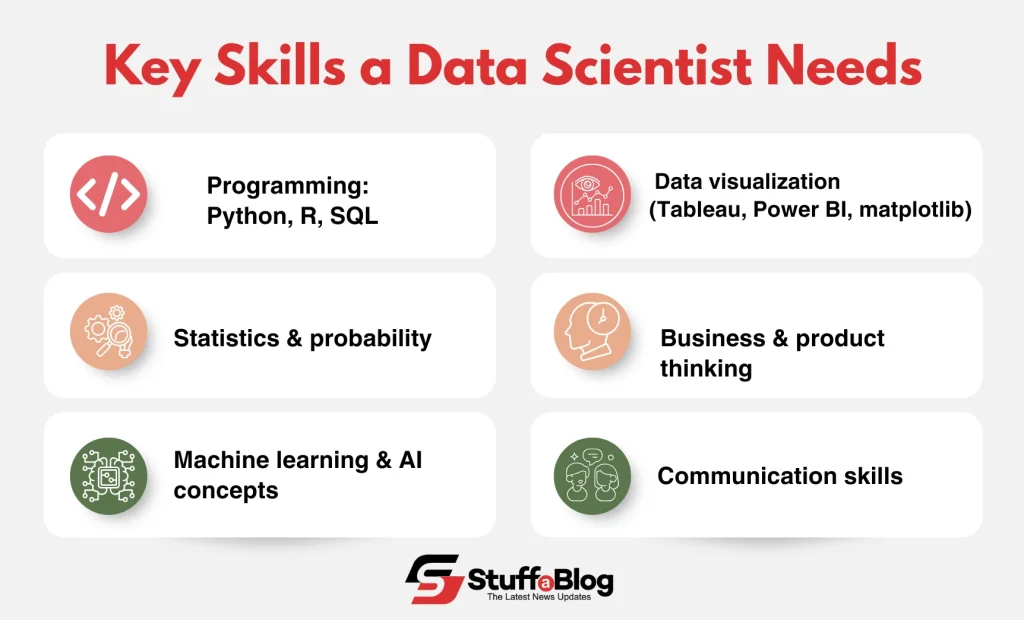
Key Skills a Data Scientist Needs
- Programming: Python, R, SQL
- Statistics & probability
- Machine learning & AI concepts
- Data visualization (Tableau, Power BI, matplotlib)
- Business & product thinking
- Communication skills
How is a Data Scientist Different From Similar Roles?
| Role | Focus |
|---|---|
| Data Analyst | Descriptive analysis & reporting |
| Data Scientist | Predictive modeling & experimentation |
| Machine Learning Engineer | Production-ready AI systems |
| Data Engineer | Data pipelines & infrastructure |
1. Data Analyst Focuses on “What happened”
A data analyst looks at past and current data to explain what is going on.
- Creates reports and dashboards
- Tracks KPIs and trends
- Answers questions like “Sales dropped last month, why?”
They describe data but usually don’t predict the future.
2. Data Scientist Focuses on “What will happen and why?”
A data scientist goes beyond reports and uses statistics and machine learning.
- Builds predictive models
- Runs experiments (A/B testing)
- Answers questions like “What will happen if we change this feature?”
They predict outcomes and guide decisions.
3. Machine Learning Engineer Focuses on “How do we run this model at scale?”
Machine learning engineers take models (often built by data scientists) and:
- Turn them into production systems
- Optimize performance and speed
- Deploy models into real apps and products
They engineer AI systems, not analyze business questions.
4. Data Engineer Focuses on “How does data flow reliably?”
Data engineers build the foundation for all data work.
- Create data pipelines
- Manage databases and warehouses
- Ensure data is clean, fast, and available
They don’t analyze data, but make sure others can.
What’s an Average Data Scientist Salary at Meta?
Meta is one of the highest-paying employers for data scientists globally, which offers a compensation model built around salary + bonus + stock (RSUs).
Estimated Meta Data Scientist Compensation As Per Levels.FYI
- Entry-level (E3): $130,000 – $160,000 total
- Mid-level (E4): $170,000 – $220,000 total
- Senior (E5): $220,000 – $300,000+ total
- Staff / Principal: $350,000 – $500,000+
Unlike many companies, Meta’s stock grants can dramatically increase real earnings, especially when the company’s performance is strong.
Real-World Example: Yann LeCun (Once)
A powerful illustration of how valuable elite data science expertise can be is Yann LeCun, who was once Meta’s Chief AI Scientist. While his role went far beyond a standard data scientist position, his compensation reflected how world-class AI and data expertise can command multimillion-dollar packages through salary, research funding, and equity.
This example shows the upper extreme of what data science leadership can achieve in Big Tech, but even non-executive data scientists at Meta benefit from the same compensation philosophy.
Data Scientist Salary at Meta vs Other Companies
Compared to most non-FAANG employers, Meta typically pays:
- 20–40% higher base salary
- Significantly larger equity grants
- Performance bonuses tied to impact, not just tenure
This makes Meta a benchmark when discussing data scientists’ earning potential.
Is Data Science Still Worth It in 2026?
Yes, arguably more than ever because the cyberage has started since 2025, and you should be more concerned about career opportunities than ever.
With AI models, personalization engines, and predictive analytics becoming core business drivers, data scientists are no longer support roles; they’re revenue roles. Companies like Meta treat data scientists as strategic assets, not cost centers.
FAQs About Data Scientist Salary
A data analyst focuses on reporting and understanding past data, while a data scientist predicts future outcomes, builds machine learning models, and runs experiments.
Yes, most data scientists need coding skills, especially Python and SQL, to analyze data, automate tasks, and build predictive models.
Data science can be challenging because it combines math, coding, and business thinking, but it is learnable with consistent practice and real-world projects.
Yes, data scientists often build and train machine learning models, which are a core part of artificial intelligence, though large-scale deployment is usually handled by machine learning engineers.