





FreeCell has been around for decades, yet it is still popular among modern flashy games. No fancy graphics. No dramatic storylines. No endless updates. Just cards, rules, and decisions. And that’s exactly why it endures.
FreeCell challenges the mind in ways few card games do. It rewards careful planning over luck, patience over impulse, and strategy over speed. While many games rely on randomness, FreeCell puts the responsibility squarely on the player’s reasoning skills.
It’s simple to learn, tough to master, and endlessly replayable—which is why it continues to stand tall among card games.
In this blog post, I will explain why FreeCell is still one of the most engaging card games and what makes it stand out.
Key Reasons Why FreeCell is the Most Engaging Card Game
- A Game Where Skill Truly Matters
- Perfect Information Creates Real Strategy
- The FreeCell Design Encourages Deep Focus
- Resource Management Keeps the Brain Busy
- Mistakes Are Clear and Educational
- Simplicity That Reveals Depth Over Time
- It Rewards Patience and Discipline
- FreeCell Encourages Long-Term Thinking
- Replayability Without Artificial Variety
- It Appeals to a Wide Range of Thinkers
Below, I will explain the every reason in detail:
A Game Where Skill Truly Matters
One of the most important reasons FreeCell stands out is its link with luck.
In many card games, the outcome is heavily influenced by chance. A bad draw can end a game before it really begins. FreeCell works differently. Nearly every FreeCell deal is solvable. When players lose, it is almost always due to decisions made along the way. This shifts responsibility entirely onto the player.
That design makes FreeCell mentally demanding in a way that luck-based games are not. Each move carries weight. There is no deck to reshuffle hope from and no random bonus to save you. Success depends on understanding the board and managing resources correctly.
This sense of accountability keeps the brain engaged. Players are not reacting to randomness. They are analyzing cause and effect.
Perfect Information Creates Real Strategy
FreeCell offers something rare in games: perfect information.
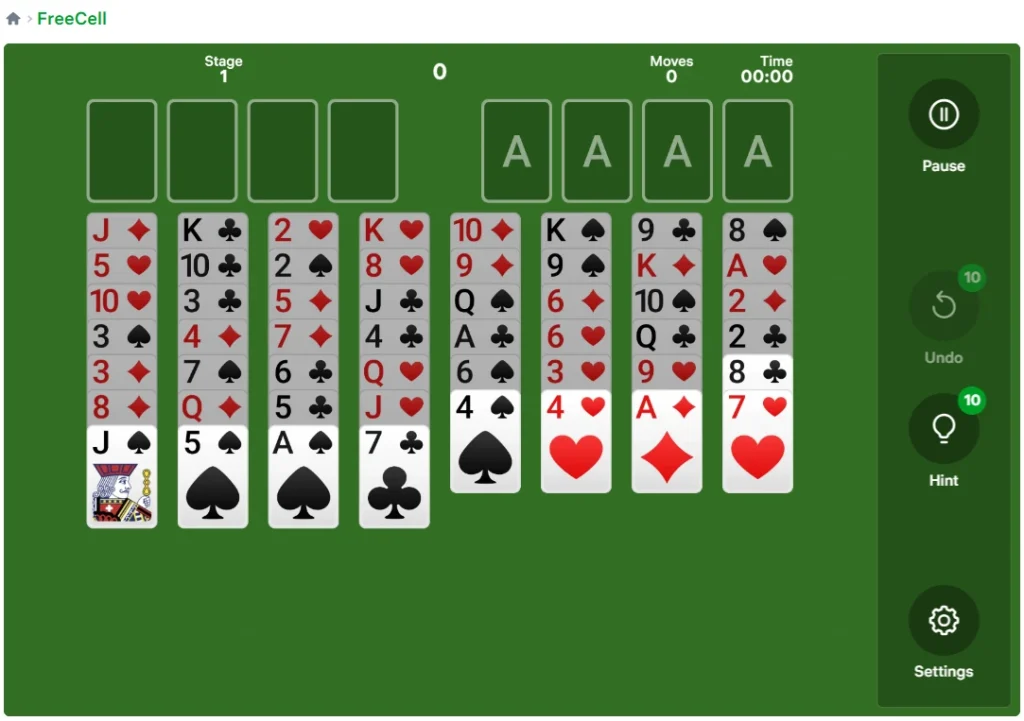
All cards are visible from the start. Nothing is hidden. There are no surprises waiting in a deck or behind a face-down card. This transforms FreeCell from a guessing game into a pure strategy puzzle.
Because everything is visible, the challenge lies in interpretation, not discovery. Players must assess the layout, identify constraints, and plan around them. Every decision is informed, yet still difficult.
Perfect information increases mental engagement because it removes excuses. When a game goes wrong, the reason is traceable. Players can review their choices and learn from them.
The FreeCell Design Encourages Deep Focus
There are no timers forcing quick decisions. No opponents applying pressure. No narrative demanding emotional investment. This allows players to settle into a state of focused concentration.
Psychologists often refer to this as a flow state, where challenge and skill are balanced. FreeCell fits this model well. The game requires enough effort to stay engaging, but not so much that it becomes overwhelming.
Players often lose track of time while playing FreeCell. That is a sign of deep cognitive engagement. The brain is fully occupied, yet not stressed.
This quality makes FreeCell especially appealing in contrast to fast-paced, attention-fragmenting games.
Resource Management Keeps the Brain Busy
It is a resource management game.
The resources are simple: free cells, empty columns, and available moves. But managing them effectively is complex. Every free cell used reduces flexibility. Every empty column created increases power. Every card moved to the foundation removes a potential tool from play.
Players must constantly balance short-term gains against long-term positioning. That balancing act is mentally taxing in a good way. It forces players to think several steps ahead while remaining adaptable.
Poor resource management leads to gridlock. Good management opens the board. This constant evaluation keeps the brain active throughout the entire game.
Mistakes Are Clear and Educational
Another reason FreeCell remains mentally engaging is how it handles failure.
When players lose, the reason is usually visible. A free cell was wasted. A column was filled too early. A low card was buried and never freed. These mistakes are not abstract. They are concrete and easy to recognize in hindsight.
This clarity makes learning satisfying. Players can replay the same deal and experiment with different approaches. Improvement feels measurable.
In contrast, games where failure feels random often discourage reflection. FreeCell invites it.
Over time, players build intuition. They start to recognize dangerous patterns before they form. That learning curve keeps the game interesting long after the rules are mastered.
Simplicity That Reveals Depth Over Time
FreeCell is easy to learn. The rules can be explained in minutes. That accessibility makes it welcoming to new players.
What keeps people playing is the depth hidden beneath that simplicity.
The same basic mechanics generate an enormous variety of situations. The challenge evolves as the player’s skill improves. Moves that once seemed clever later reveal themselves as risky. Strategies that worked early stop working against more complex layouts.
This layered depth is a hallmark of mentally engaging games. They grow with the player instead of becoming predictable.
It Rewards Patience and Discipline
FreeCell does not reward impulsive play. Quick moves without thought often lead to blocked columns and filled free cells. Players learn, sometimes painfully, that slowing down leads to better results.
This emphasis on patience sets FreeCell apart from many modern games that prioritize speed and constant input. FreeCell encourages players to pause, think, and commit intentionally.
That discipline is mentally engaging because it requires self-control. The challenge is not just the board. It is resisting the urge to act without a plan. Over time, players internalize this rhythm. Thought precedes action.
FreeCell Encourages Long-Term Thinking
Winning a FreeCell game often depends on decisions made early on.
A move that feels helpful in the first few minutes can quietly sabotage the endgame. That forces players to consider consequences beyond the immediate moment.
Long-term thinking is cognitively demanding. It requires holding future possibilities in mind while navigating present constraints. FreeCell constantly exercises this skill.
This is especially true when deciding whether to move cards to the foundation. Doing so feels productive, but may reduce future options. Balancing that tradeoff keeps players mentally engaged from start to finish.
Replayability Without Artificial Variety
Many games rely on constant updates, new content, or randomized elements to stay fresh. FreeCell relies on none of these.
Its replayability comes from the sheer number of possible layouts and the complexity of decision-making within each one. Even familiar deals can feel new when approached with different strategies.
This form of replayability is mentally engaging because it is internal rather than external. The novelty comes from the player’s thinking, not from added features.
That is one reason FreeCell has survived technological shifts and changing trends. It does not depend on novelty to remain interesting.
It Appeals to a Wide Range of Thinkers
FreeCell attracts different kinds of players for different reasons. Analytical thinkers enjoy optimizing moves and planning sequences. Casual players enjoy the calm focus it provides. Competitive players enjoy improving their win rate and solving difficult boards.
Because the game does not force a single playstyle, it remains accessible while still rewarding depth. That broad appeal keeps its community alive across generations.
Final Thoughts – FreeCell Still Winning Hearts
FreeCell remains one of the most mentally engaging card games because it respects the player. It doesn’t rely on luck or spectacle—it challenges you to think, plan, and improve. In a noisy gaming world, FreeCell offers clarity. In a culture that rewards speed, it rewards thought. And that’s why players keep coming back, year after year.