





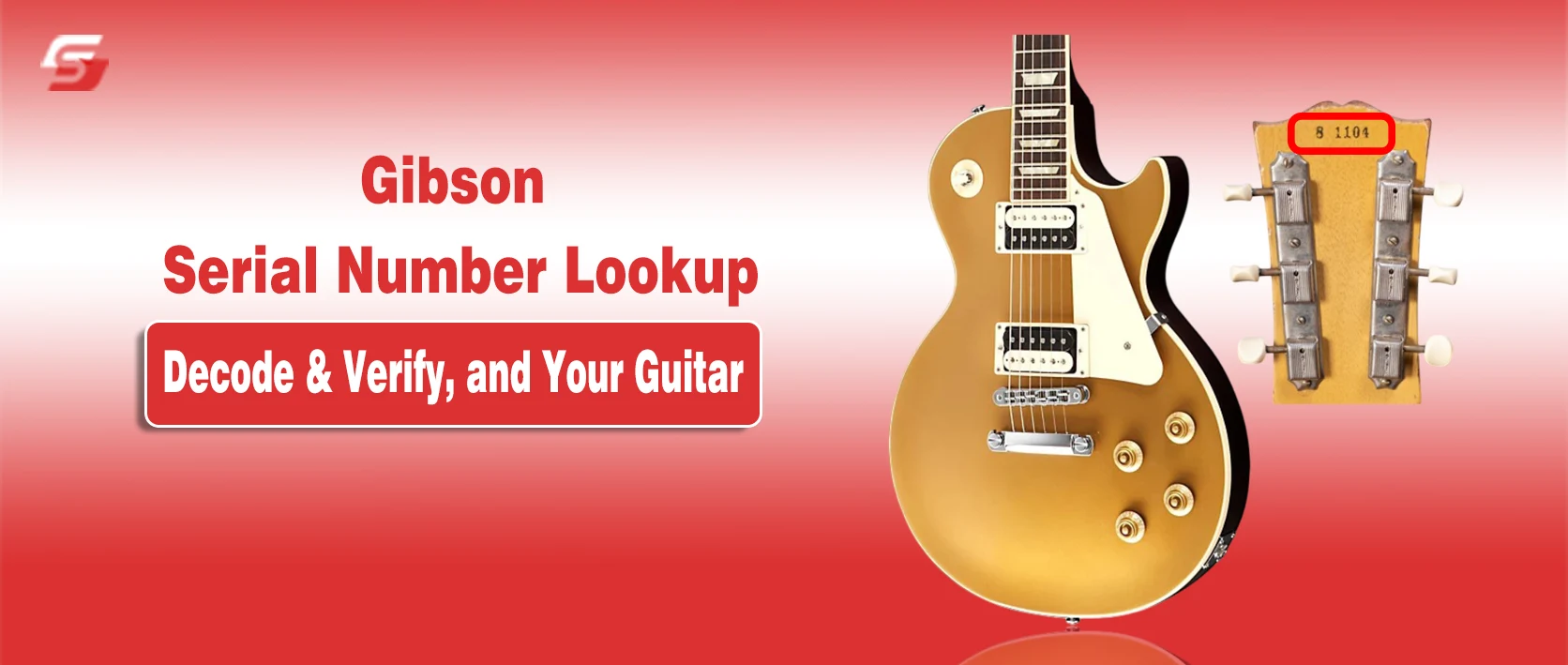
A gibson serial numbers search engine tells you the exact year, factory, and production details of a Gibson guitar, and the fastest way to check it is by using Gibson’s official serial number lookup or a trusted verification tool.
Most Gibson serials follow patterns that reveal the instrument’s build date, model batch, and manufacturing location, so learning how to read these numbers helps you confirm authenticity, spot inconsistencies, and understand the guitar’s history and value.
In this guide, we explore how to decode, verify, and interpret Gibson serial numbers, uncovering the secrets behind one of the world’s most iconic guitar brands. Whether you own a vintage Les Paul, a modern SG, or a rare Custom Shop edition, understand serial numbers.
What Are Gibson Serial Numbers?
gibson guitar identification serial numbers are unique identification codes assigned to guitars, basses, and other Gibson instruments to document their manufacturing date, production location, and authenticity.
Each serial number functions as a historical record, linking an instrument to its factory of origin, model type, and gibson year by serial number of production. Gibson uses serial numbering to ensure traceability, support warranty verification, and help collectors confirm originality.
Gibson serial numbers work allows owners to date instruments accurately, recognize counterfeits, and determine the production period of vintage guitars like the Les Paul, SG, or ES-335.
How to Locate Your Gibson Serial Number?
Gibson serial numbers are placed strategically on guitars to verify their authenticity, model year, and production origin.
Primary Gibson serial number locations include:
- Back of the Headstock: Found on most Les Paul, SG, Explorer, and Flying V models. The number is either imprinted, stamped, or engraved, depending on the year.
- Neck Block (Inside the Soundhole): Used on acoustic guitars such as the J-45, Hummingbird, and Dove, often printed or stamped on a paper label.
- Inside the Body Cavity: On semi-hollow models like the ES-335 or ES-175, the serial number appears on an orange or white factory label visible through the f-hole.
- Control Cavity or Neck Heel: Rarely, certain Custom Shop or vintage reissues display serials inside the electronic cavity or near the neck joint for added authenticity protection.
Quick Reference Table For Serial Number Location:
| Model Type | Common Serial Location | Marking Style |
| Les Paul / SG | Back of headstock | Impressed or ink-stamped |
| ES-335 / ES-175 | Inside body, visible through f-hole | Paper label |
| J-45 / Hummingbird | Inside soundhole on neck block | Paper or ink stamp |
| Custom Shop | Back of headstock or control cavity | “CS” prefix, engraved |
| Vintage models (pre-1952) | Back of peghead or label inside | Ink-stamped or handwritten |
Correctly identifying the serial placement helps verify whether the instrument aligns with known Gibson manufacturing standards for its era.
What a Gibson Serial Number Reveals
A Gibson serial number reveals several key attributes of an instrument:
- Manufacture Year – the production year based on number sequence or date code
- Factory Location – the plant where the instrument was built (e.g., Kalamazoo, Nashville, Bozeman)
- Production Batch – indicates the order of instruments made in a specific batch or day
- Model Verification – confirms if the guitar belongs to the correct model family
- Authenticity Indicator – helps detect fake or duplicated instruments
For example, a Gibson Les Paul serial number such as 82345678 can indicate:
- Year: 1985 (first and fifth digits)
- Day of Year: 234
- Production Number: 678
This system helps verify both manufacture date and factory sequence.
How to Read Gibson Serial Numbers
Gibson serial numbers provide structured information that identifies a guitar’s manufacture year, production date, and factory origin.
Each number follows a specific format based on the era, factory, and model type, allowing collectors, musicians, and buyers to trace a guitar’s production history.
Step-by-Step Decoding of 4-, 6-, 8-, and 9-Digit Formats
Each Gibson serial format represents a distinct production period. Understanding the structure of these number patterns allows precise dating and model identification.
1. 4-Digit Serial Numbers (1952–1961)
- Used on early Les Paul and ES models
- Sequential format without factory or date information
- Example: 2345 → indicates only production order, not the year
2. 6-Digit Serial Numbers (1961–1974)
- Adopted during mass-production years
- Numbers often repeated annually, requiring cross-check with model specs
- Example: 123456 → may correspond to different years depending on model
3. 8-Digit Serial Numbers (1975–1999)
- Introduced Gibson’s YDDDYPPP system
- Format defines year, day of year, and plant/production number
- Example: 82765543 → Year 1986, 276th day, 543rd instrument made
4. 9-Digit Serial Numbers (2000–Present)
- Used for modern Gibson USA and Custom Shop guitars
- Adds an extra digit to separate factory identifiers and avoid duplication
- Example: 025230456 → 2003, 252nd day, 304th instrument built
| Format | Years Active | Structure | Information Revealed |
| 4-digit | 1952–1961 | Sequential | Production order only |
| 6-digit | 1961–1974 | Sequential | Batch order, limited date info |
| 8-digit | 1975–1999 | YDDDYPPP | Year, day, plant, and production |
| 9-digit | 2000–Present | YDDDYPPPP | Full manufacturing traceability |
Manual Decoding vs. Lookup Databases | Which Is More Reliable?
Manual decoding allows experienced players and collectors to read serial numbers without external tools, but lookup databases provide higher accuracy for newer and transitional models.
Advantages of Manual Decoding:
- Works well for vintage instruments with simple numbering
- Requires only the serial imprint and reference chart
- Useful when no internet access or official lookup page is available
Lookup Database Advantages:
- Pulls data from Gibson’s official registry or factory archives
- Confirms year, plant, and model type with fewer human errors
- Detects duplicate, fake, or reused serials
Example: Decoding a 9-Digit Gibson Serial Number
To illustrate, consider the serial number 025230456.
Following Gibson’s 9-digit format, each digit provides specific manufacturing data:
| Digit Group | Meaning | Example Data |
| 0 | Decade indicator | 2000s |
| 25 | Production year | 2003 |
| 230 | Day of year | August 18 |
| 456 | Production rank | 456th guitar made that day |
Decoded Result:
A Gibson guitar with serial 025230456 was built on August 18, 2003, as the 456th instrument produced that day, likely from the Nashville or Memphis plant depending on the model.
Gibson Serial Number Lookup Tools and Databases
The Gibson brand offers both its own and third‑party tools to support serial number lookup, manufacture date verification, and instrument authentication. These resources help owners, buyers, and dealers access factory data, batch details, and origin information in a reliable, efficient manner.
Using Gibson’s Official Serial Lookup Page
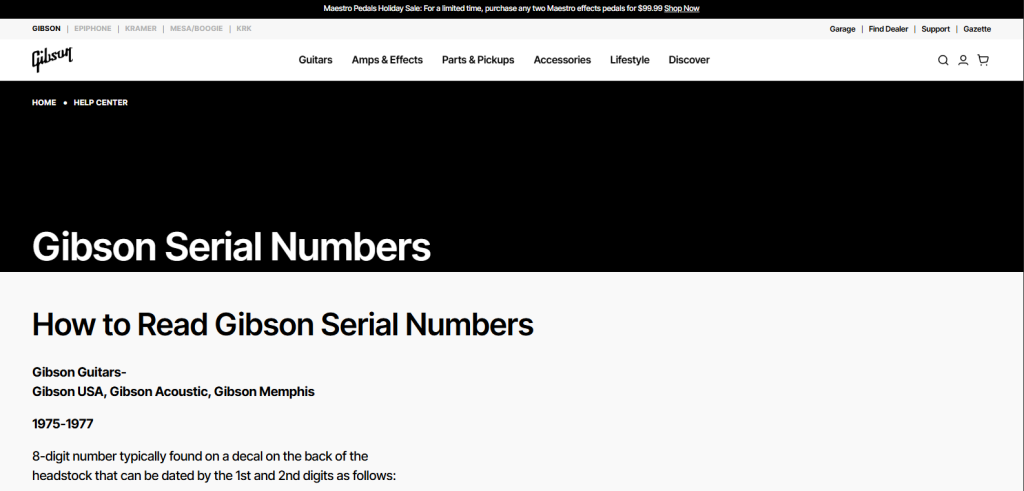
The Gibson website hosts an official “Serial Number Search” system that covers guitars built from 1975 onward.
- Users can enter a serial number to retrieve the manufacture year and factory location.
- Gibson confirms that the lookup applies to instruments “manufactured or distributed by Gibson Guitar Corporation”.
- Because the data originates from Gibson’s internal records, this lookup offers the highest‑level brand verification.
Reliable Third‑Party Checkers (Reverb, The Guitar Dater Project, etc.)
Independent platforms supplement Gibson’s official tool with additional lookup charts and community‑databases.
- The Guitar Dater Project offers a Gibson serial number decoder covering multiple formats.
- Reverb publishes dating guides and serial‐number charts for Gibson instruments.
- While useful, these checkers may not reflect the full internal Gibson database and should be used as complementary tools.
Common Reasons for Mismatched or Missing Serial Results
Several factors can cause a Gibson serial number to produce unexpected or missing results:
- Refinishing or Repairs – Sanding or repainting the headstock or body can partially remove the serial number.
- Factory Re-stamping – Rare cases exist where numbers were re-stamped due to production errors or adjustments at the plant
- Counterfeit or Fraudulent Instruments – Fake or modified guitars may use copied or duplicated serial numbers
- Label Deterioration – Paper labels in acoustic guitars, such as J-45 or Hummingbird, may fade over decades.
- Incorrect Documentation – Data entry errors in third-party databases or online lookup tools can yield inconsistent results.
Recognizing these conditions ensures accurate evaluation of whether a Gibson guitar serial number is authentic or altered.
How to Contact Gibson Support for Official Verification
Gibson Customer Support manages official verification for instruments with mismatched or missing serial numbers.
- Visit Gibson’s official support page: gibson.com/contact
- Provide high-resolution photos of the headstock, neck block, f-hole label, or control cavity showing the serial number.
- Include model name, approximate production year, and any purchase documentation.
- Gibson can confirm manufacturing date, plant origin, and model specifications from internal factory records.
- Response times may vary depending on the guitar’s production era and the completeness of submitted documentation.
Official support ensures a brand-verified record of the instrument’s production details and authenticity. Just like verifying a check requires attention to detail and accuracy, decoding a Gibson serial number also depends on reading precise identifiers correctly.
Verify Gibson Serial Numbers with Confidence
Gibson serial numbers reveal a guitar’s production year, factory, model, and production line. Understanding them helps owners, collectors, and buyers confirm authenticity, trace history, and assess value.
Use official lookup tools, trusted third-party checkers, and mobile verification apps to decode serial numbers quickly. Keep updated records and photos to maintain long-term provenance and resale reliability. This guide provides all essential steps, tips, and resources in one practical reference.
Frequently Asked Questions
Genuine Gibson guitars have unique serial numbers, though rare re-stamping or errors may cause duplicates in records.
Gibson’s official lookup provides brand-verified production dates and factory information for guitars made from 1975 onward.
No official public registry exists, but third-party databases like The Guitar Dater Project track serial patterns.
Examine model type, factory codes, labels, hardware, and finishes, then cross-check with verified lookup tools.
Third-party checkers indicate probable production details but should be verified with Gibson’s official records.