






When it comes to financial decisions, more information is almost always better. So, when it comes to pricing a mortgage, making sure you get the right type of report is key.
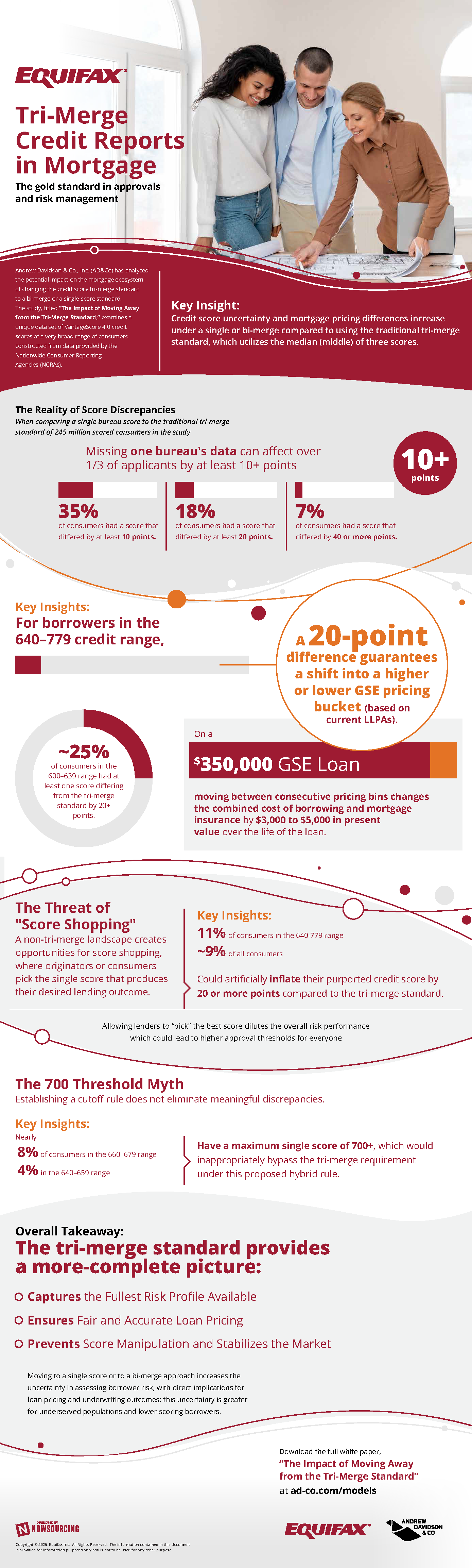
There is greater uncertainty and fluctuation with credit scores and mortgage prices when using a single or bi-merge compared to the standard tri-merge credit report.
In fact, missing data from one bureau led to a 10-point credit score difference in 35% of consumers, a 20-point difference in 18% of consumers, and a 40+ score difference in 7% of consumers.
In turn, these credit differences affect the consumer’s GSE bucket and can ultimately affect a loan’s price by up to $5,000 on a standard $350,000 GSE loan.
Moreover, using incomplete credit reports presents an arbitrage opportunity for consumers. Basically, since multiple lenders are giving a consumer different prices on the same loan, they can select a loan where their credit scores look like the best, regardless of which one they actually have.
It is estimated that consumers see around a 20-point jump by using this method. This affects people on the cusp of a new GSE bucket the most, as they can obtain a price much better than what they are actually eligible for.
Overall, one thing is simple. The more data provided for pricing a mortgage, the better. Financial decisions rarely depend on a single factor. Along with maintaining a healthy credit profile, understanding important financial documentation can help consumers make more informed long-term decisions.
While there are many types of ways to order a credit report, it’s clear that the traditional tri-merge credit report paints the fullest and most accurate picture.
In turn, this guarantees that mortgage lenders neither overcharge their customers nor underprice their product. It also ensures no one person can game the system to try to earn a better rate. Ultimately, if you want to ensure that you are accurately and fairly pricing your loans, a tri-merge credit report is the way to go.
Source: Equifax